Percentile Rank Vs Normal Curve Equivalent Star Reading
By Catherine Close, PhD, Psychometrician
Test scores are of much interest to parents and educators. We all want our children to achieve their best—and then, we frequently use tests to measure out what a pupil has learned and can do as a consequence of instruction. Sometimes we want to estimate progress, but oft we make important decisions such as placement in intervention or advanced classes, grade promotion, and so on.
If nosotros are going to utilise test scores for these types of decisions, we need to ensure that the scores are meaningful . And then, let'due south talk about how we give meaning to scores.
Some Requirements
First, consider the quality of the examination. As we discussed in a previous blog, we look for high reliability of scores and convincing testify of validity.
Second, even with a good exam, scores are inherently meaningless. Yes, that's true. Take something commonplace such equally taking your temperature. Whatever your temperature is, you lot wouldn't know whether it's skillful or bad without something to compare information technology to. That something is the noesis that 98.half-dozen° F is considered the normal body temperature.
In this example, 98.6° F is what nosotros phone call a standard or a norm to which we compare our temperature measurements. Knowing that standard immediately gives pregnant to your number every bit depression or high or whatever the case might be.
The same is true for educational test scores. For scores to have meaning, we must have a well-defined standard or norm to which we compare the scores. We define that standard or norm using two main approaches: a benchmark-referenced arroyo and a norm-referenced approach . Allow me say here that you lot couldn't tell the difference between a criterion-referenced examination and a norm-referenced test just past looking at one. This is because the difference is in the scores. Nosotros study different scores based on the interpretations we desire to make.
Let'southward take an case of a third grade educatee. This pupil has tested in Renaissance Star Reading® in the beginning month of the school twelvemonth and scored at 365. What are some of the possible interpretations of that score?
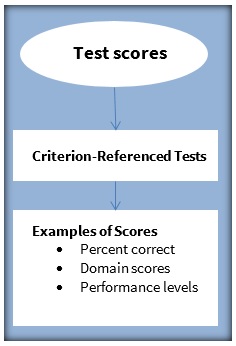 Criterion-Referenced Interpretations
For criterion-referenced interpretations, we look for scores that describe the specific cognition and skills that the student has almost probable achieved. The standard against which the 365 score is judged can exist every bit uncomplicated as percentage of tasks performed correctly (due east.g., answering 80% of the items correctly); or performance levels such every bit Beneath Basic, Basic, Practiced, and Advanced. The standard in this case is commonly referred to as a benchmark. Any the criterion, the goal is to assess where the educatee'due south level of knowledge and skills is in relation to that criterion. Nosotros so only land whether the student has mastery or not, is proficient or non, and so on.
In computerized adaptive tests, students don't come across the same exact questions so the percentage of questions answered correctly is not a meaningful metric. Nevertheless, nosotros tin apply item response theory to compute what we call domain scores . Domain scores range from 0 to 100 and show the average level of skill mastery for students who obtain a given score. If our tertiary grader – based on the 365 score- has a domain score of 84 in language, this means that he or she has probable mastered 84% of the content in the linguistic communication domain. A similar estimation holds across the other domains tested in Star Reading and you lot can encounter the profile of this educatee's expected content mastery, domain past domain. If your criterion is say 70% mastery in all domains, then this student is clearly to a higher place that in the language domain and you might be looking for more challenging materials to go on the student engaged.
Another type of score that may be of interest is the student's operation level . If the Star Reading cut-score that defines the expert category for 3rd graders is 375, and then this student falls brusk by 10 score points. But, since this is the first month of the school yr, you might feel confident that they'll be proficient in reading at the end of third grade.
The Star assessments also provide benchmark-referenced criterion scores at the state level. A benchmark is the everyman level of performance considered acceptable. If Star Reading is linked to your land exam, the state benchmarks show you the reading proficiency level on the land test that corresponds to the 365 Star Reading score. In this sense, the Star state benchmarks provide a glimpse into the 3rd grader's near likely proficiency level in the country test at the end of year.
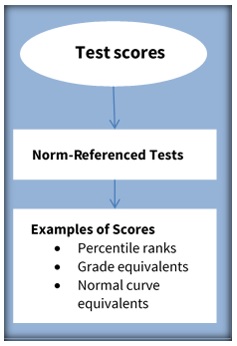 Norm-Referenced Interpretations
For norm-referenced interpretations, we look for scores that compare the performance of our tertiary grader to the performance of other tertiary class students across the nation. These other 3rd class students form what nosotros phone call a norm group . That norm group doesn't always accept to exist other students in the same grade. It can also exist students of the same age, same special status such as English language language learners (ELL) or special education, amid others.
However, it's more than common in the United states to compare students with other students in the same course across the nation. Some of the scores that we look for hither are percentile ranks (PR) and grade equivalents (GE). Suppose our third grader'south score of 365 corresponds to say a PR of 50 and a GE of iii.1. The PR of l ways that this student did better than fifty% of the tertiary class students in the national norm group who examination in the offset calendar month of the school year. The GE score of 3.1 means that this student is performing like the average educatee in the beginning month of third grade. There might also be standard scores such as the normal curve equivalents (NCE) that are reported due to their convenience for algebraic manipulations but the PRs and GEs are the almost widely used norm-referenced scores.
Star also provides norm-referenced criterion scores at the district and at the schoolhouse level. These benchmarks are based on the existing Starnational norms and the nationally accepted recommendations defined as follows:
- At/Above Benchmark = At/higher up 40th percentile
- On Watch = 25th to 39th percentile
- Intervention = 10th to 24th percentile
- Urgent Intervention = Below tenth percentile
These norm-referenced benchmarks can be modified to be state of affairs specific just the default percentile ranks presented higher up are helpful in determining who needs intervention and who is conspicuously above benchmark. Our tertiary grader's score has PR=50 which is above criterion.
How to Determine the Best Score Interpretation for your Plan
Considering the norm-referenced and the criterion-referenced interpretations serve dissimilar purposes, none is better than the other. You choose based on your testing needs. If the goal is to pin down mastery of content, and then the criterion-referenced arroyo is the fitting pick. If comparing a student'due south operation to a norm group is important, then the norm-referenced approach rules the solar day. If you want both the norm-referenced and the criterion-referenced interpretations, yous can certainly have both! Whatever the demand, information technology'southward proficient to go on in mind the following: norm-referenced scores don't really tell you what the student has learned in terms of content mastery as they are used to compare pupil based on some norm group of interest; criterion-referenced scores don't let us to compare operation across students equally we are interested in the skills each student has mastered in relation to some criterion.
I hope I've provided you with insight into why scores mean different things, the reasoning behind those differences, and how your needs for score employ make up one's mind which estimation is best for you. We've also written previous posts almost other facets of test scores, which can be accessed using the links beneath:
Understanding the reliability and validity of exam scores
The basics of exam score reliability for educators

Source: https://www.renaissance.com/2016/05/12/giving-meaning-to-test-scores/
0 Response to "Percentile Rank Vs Normal Curve Equivalent Star Reading"
Post a Comment